

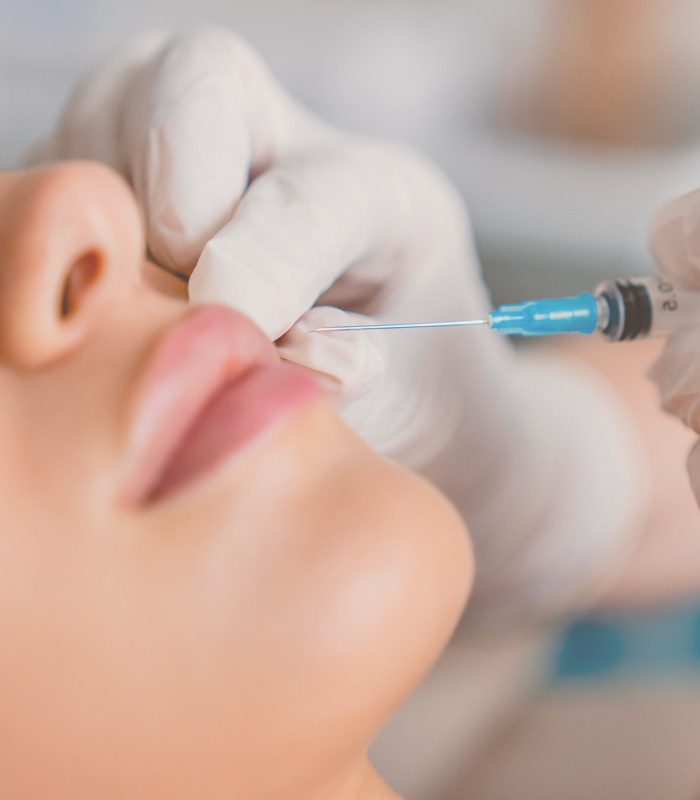
Dermal Fillers
As you age, your body starts to produce less collagen. Collagen is a substance that occurs naturally in your body and acts as a framework for your skin. As a result, the skin gets thinner and begins to sag.
Want to smooth out moderate-to-severe facial wrinkles?
Simultaneously, the face loses volume due to decreased facial fat and resorption of the underlying bone. If you want to smooth out moderate-to-severe facial wrinkles and skin folds like deep nasolabial folds (laugh lines), soften marionette lines, increase the fullness of the lips, cheeks, chin, under-eye hollows, jawline, and back of the hand, restore facial fat loss or just correct acne scars on the face then the perfect solution would be to get DERMAL FILLERS.
Reshape your face’s contours and redefine your lips and..
Dermal fillers do exactly as the name suggests -they fill a wrinkle from the inside out. Dermal fillers are thus injectable anti-ageing treatments that are used to treat fine lines, deep folds, and volume loss in the face. The treatment helps reshape the face’s contours, re-define features such as lips, rehydrate the skin and smooth out wrinkles. They are also used to treat dark lines under the eyes and smokers’ lines. Dermal fillers are made of a variety of substances. The most popular and safest are made of hyaluronic acid (HA), a naturally occurring substance found in our skin that can hold water and acts as a cushion-like sponge. This hydrates the skin and acts like a lubricant to reduce damage to the skin, resulting in a youthful, supple, and elastic appearance.
Dermal fillers can be done without surgery and without pain. This is truly LIVING ART!
What is it?
Hyaluronic Acid (HA) is a substance naturally found in your skin, joints, and eyes. Its primary function is to bind to water, providing hydration, volume, and a plumping effect that keeps skin looking youthful and supple. As we age, our natural production of HA decreases, leading to the formation of wrinkles, loss of facial volume, and skin laxity.
Hyaluronic Acid Dermal Fillers are injectable gels designed to replenish this lost HA. They are a non-surgical treatment used to:
- Restore Volume: Add fullness to areas like the cheeks, temples, and under the eyes.
- Smooth Wrinkles and Folds: Diminish the appearance of lines such as nasolabial folds (lines from the nose to mouth) and marionette lines (lines from the mouth to chin).
- Enhance Lips: Add volume, definition, and shape to the lips.
- Improve Skin Hydration and Quality: Stimulate collagen production and improve overall skin texture.
The key advantage of HA fillers is their reversibility. If a patient is unhappy with the result, an enzyme called hyaluronidase can be injected to dissolve the filler, quickly reversing its effects.
What to Expect? (The Treatment Process)
A HA filler treatment is a straightforward, in-office procedure that typically takes 15 to 60 minutes.
- Consultation: This is the most important first step. You will meet with a qualified medical professional (such as a doctor, nurse, or physician assistant) to discuss your goals, medical history, and determine if you are a good candidate. They will explain the procedure, potential risks, and create a personalized treatment plan.
- Preparation: The treatment area will be cleansed. A topical numbing cream may be applied to minimize discomfort. Many modern HA fillers also contain a local anesthetic (lidocaine) within the gel for added comfort during and after the injection.
- The Injection: Using a fine needle or cannula (a blunt-tipped tube), the provider will strategically inject the HA gel into the targeted areas of your skin. They may ask you to make certain facial expressions to ensure natural-looking results.
- Immediate Aftermath: You may experience mild redness, swelling, bruising, or tenderness at the injection sites. This is normal and usually resolves quickly. The provider may gently massage the area to ensure the filler is evenly distributed.
- Seeing Results: Results are often immediately visible. However, the final, settled result will appear after any initial swelling subsides, usually within 1 to 2 weeks.
Results typically last between 6 to 18 months, depending on the product used, the area treated, and individual factors like your metabolism and lifestyle.
Are there risks involved?
While Hyaluronic Acid fillers are considered very safe when administered by a qualified professional, all medical procedures carry some potential risks. It is crucial to be aware of them.
Common, Temporary Side Effects:
- Redness
- Swelling
- Bruising
- Tenderness or pain at the injection site
- Itching
These effects are usually mild and resolve on their own within a few days.
Less Common, More Serious Risks:
- Lumps or Bumps: Irregularities under the skin that may require massage or correction.
- Infection: Though rare, any injection can introduce bacteria.
- Allergic Reaction: Modern HA fillers are highly purified, making true allergies extremely rare.
- Nerve Injury: Temporary weakness or numbness in the treated area.
- Discoloration or Skin Necrosis: This occurs if filler is accidentally injected into a blood vessel, blocking blood flow. This is a medical emergency and requires immediate attention. A skilled injector’s knowledge of facial anatomy is critical to minimize this risk.
Choosing an experienced, licensed, and qualified medical professional is the single most important factor in ensuring your safety and achieving optimal results.
Aftercare
Proper aftercare is essential for minimizing side effects and ensuring the best possible outcome.
For the first 24-48 hours, AVOID:
- Strenuous exercise
- Alcohol, as it can increase bruising and swelling.
- Blood-thinning medications (like aspirin, ibuprofen, and certain supplements – unless prescribed by your doctor).
- Touching, rubbing, or applying pressure to the treated area.
- Makeup on the injection sites for at least 12 hours.
- Extreme heat (saunas, steam rooms, hot yoga) or extreme cold.
- Sleeping on your face; try to sleep on your back.
What you SHOULD do:
- Apply a cool compress (not ice directly) to the area to reduce swelling and bruising.
- Gently move the treated muscles as directed by your provider (e.g., smiling, puckering) to help the product integrate naturally.
- Stay hydrated by drinking plenty of water.
- Attend your follow-up appointment if one is scheduled, typically around 2-4 weeks post-treatment, to assess the results.
Contact your provider immediately if you experience:
- Severe or increasing pain.
- Vision changes, sudden vision loss, or a white/blotchy appearance of the skin.
- Signs of infection (e.g., fever, pus, excessive heat, and redness).
Disclaimer: This information is for educational purposes only and does not constitute medical advice. Always consult with a qualified healthcare professional to discuss your individual needs and determine if a treatment is right for you.