

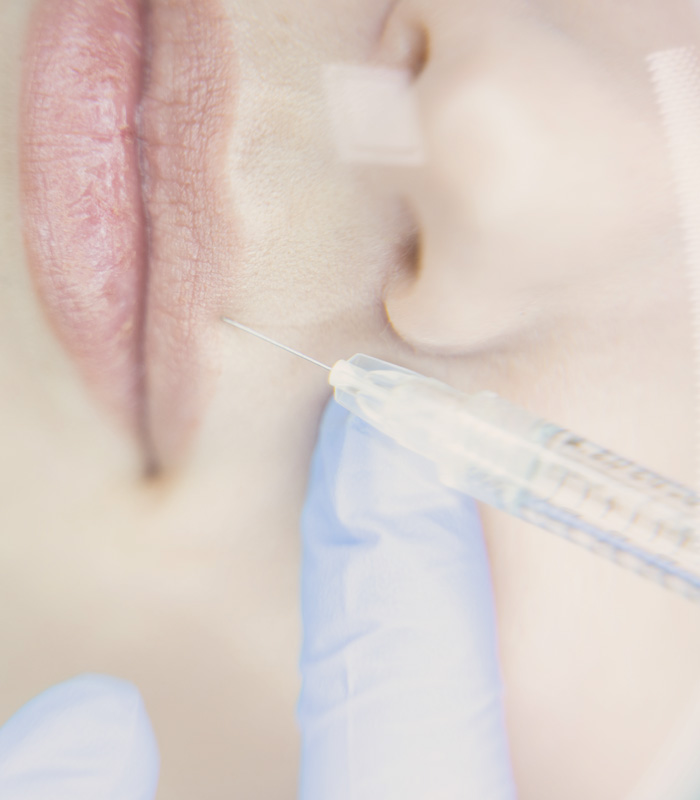
Elective Dermal Filler Dissolving
As you age, your body starts to produce less collagen. Collagen is a substance that occurs naturally in your body and acts as a framework for your skin. As a result, the skin gets thinner and begins to sag.
Want to smooth out moderate-to-severe facial wrinkles?
Simultaneously, the face loses volume due to decreased facial fat and resorption of the underlying bone. If you want to smooth out moderate-to-severe facial wrinkles and skin folds like deep nasolabial folds (laugh lines), soften marionette lines, increase the fullness of the lips, cheeks, chin, under-eye hollows, jawline, and back of the hand, restore facial fat loss or just correct acne scars on the face then the perfect solution would be to get DERMAL FILLERS.
Reshape your face’s contours and redefine your lips and..
Dermal fillers do exactly as the name suggests -they fill a wrinkle from the inside out. Dermal fillers are thus injectable anti-ageing treatments that are used to treat fine lines, deep folds, and volume loss in the face. The treatment helps reshape the face’s contours, re-define features such as lips, rehydrate the skin and smooth out wrinkles. They are also used to treat dark lines under the eyes and smokers’ lines. Dermal fillers are made of a variety of substances. The most popular and safest are made of hyaluronic acid (HA), a naturally occurring substance found in our skin that can hold water and acts as a cushion-like sponge. This hydrates the skin and acts like a lubricant to reduce damage to the skin, resulting in a youthful, supple, and elastic appearance.
Dermal fillers can be done without surgery and without pain. This is truly LIVING ART!
Elective Filler Dissolving with Hylase: A Comprehensive Guide
While hyaluronic acid (HA) fillers are a popular and generally safe treatment for adding volume and smoothing wrinkles, sometimes the results may not be exactly what you envisioned. Whether you’re experiencing a minor asymmetry, are unhappy with the overall look, or have a complication like a lump, elective filler dissolving offers a safe and effective solution.
This guide will provide you with essential information about the process of dissolving HA filler using an enzyme called Hylase.
What is Hylase and Who is a Good Candidate?
What is it?
Hylase is a brand name for a purified enzyme called hyaluronidase. This enzyme occurs naturally in your body and works by breaking down hyaluronic acid, a key component of your skin’s connective tissue and the same substance used in most dermal fillers.
When injected into an area treated with HA filler, Hylase acts like a “dissolver,” rapidly breaking down the filler particles so your body can safely absorb and eliminate them. It is the only approved and effective method for reversing HA fillers.
Who is a Good Candidate?
You may be a good candidate for elective filler dissolving with Hylase if you:
- Are Unhappy with Your Aesthetic Results: This includes filler that looks overdone, “duck lips,” an uneven or asymmetrical appearance, or a look that simply doesn’t suit you.
- Have Visible Lumps or Bumps: Filler can sometimes clump together, leading to visible or palpable irregularities under the skin.
- Want to Start Fresh: You wish to remove old filler before having a new treatment to achieve a more optimal result.
- Are Experiencing a Complication: Such as filler migrating to an unwanted area or, in rare cases, a vascular occlusion (where filler blocks a blood vessel), where dissolving is a critical emergency treatment.
- Have Had an Allergic Reaction: Although rare with HA fillers, Hylase can be used to manage allergic responses by removing the source.
Important Note: You should not undergo this procedure if you have a known allergy to hyaluronidase, bee stings (as the enzyme is similar to one found in bee venom), or if you are pregnant or breastfeeding.
What to Expect During the Procedure
The dissolving process is straightforward and similar to receiving the filler injection itself.
- Consultation: First, your medical practitioner will assess the area, discuss your concerns, and confirm your suitability for the procedure. They will explain the expected outcomes and any potential risks.
- Preparation: The treatment area will be cleansed. A topical numbing cream may be applied to minimize discomfort, though many patients find the injections very tolerable.
- The Injection: Using a very fine needle, your practitioner will inject small amounts of Hylase solution into and around the filler that needs to be dissolved. The number of injections will depend on the size and location of the area being treated.
- Massage: Immediately after the injection, your practitioner will gently massage the area to help distribute the Hylase and break down the filler.
- Duration: The entire process typically takes only 15 to 30 minutes.
Are There Risks Involved?
Like any medical procedure, dissolving filler with Hylase carries potential risks and side effects, though they are generally mild and temporary. Your practitioner will discuss these with you in detail.
Common, Temporary Side Effects:
- Redness, swelling, and bruising at the injection sites.
- Tenderness or itching.
- These usually resolve within 24-48 hours.
Less Common Risks:
- Allergic Reaction: Ranging from mild redness and itching to a more severe reaction. An allergy test can be performed beforehand if there is a concern.
- Over-dissolution: Hylase breaks down both the injected filler and your body’s natural hyaluronic acid. Using too much can lead to a temporary loss of your natural volume, making the area appear slightly sunken. This is why an experienced practitioner uses a conservative approach. Your natural HA will replenish over several weeks.
- Infection: As with any injection, there is a minimal risk of infection.
Choosing a qualified and experienced medical professional is the best way to minimize these risks and achieve a natural-looking result.
Aftercare: What to Do After Your Treatment
Proper aftercare is crucial for a smooth recovery and optimal results.
Immediately After & For the First 24-48 Hours:
- Apply a Cold Compress: Gently apply a cold pack to the area for 10-15 minutes at a time to reduce swelling and bruising. Always place a cloth between the ice and your skin.
- Avoid Heat: Stay away from saunas, steam rooms, hot showers, and strenuous exercise, as heat can increase swelling.
- Be Gentle: Avoid touching, rubbing, or massaging the treated area unless instructed by your practitioner.
- Sleep Elevated: Try to sleep with your head elevated on an extra pillow to help minimize swelling.
- Stay Hydrated: Drink plenty of water.
Longer-Term Care:
- Avoid Makeup: Wait at least 12 hours before applying makeup to the area to prevent infection.
- Be Patient: You may see initial results within 24 hours, but the full dissolving effect can take up to 2 weeks. Your practitioner will assess if a follow-up session is needed.
- Follow Up: Attend any scheduled follow-up appointments so your practitioner can evaluate the results.
If you experience severe or increasing pain, significant swelling that does not subside, blistering, or signs of an allergic reaction (like hives or difficulty breathing), contact your healthcare provider immediately.
Disclaimer: This information is for educational purposes only and does not constitute medical advice. Always consult with a qualified healthcare professional, such as a doctor or nurse prescriber, to determine the best treatment plan for your individual needs.